Quick overview
Invunion reconciles customer payments by connecting four core objects: counterparties, payment methods, transactions, and issued invoices. This overview shows how those records relate, what each relationship means for day-to-day review, and the recommended order for reading the detailed object articles that follow.
Browse documentation
The four objects that matter for reconciliation
Invunion stores the data you reconcile as related records. For customer payments and refunds, four objects do most of the work:
- Counterparties: the customers (and other parties) your invoices and cash movements relate to.
- Payment methods: the instruments that identify how money moves, such as an IBAN or a known payment-provider pattern.
- Transactions: the bank or imported cash lines that need to be matched or reviewed.
- Invoices issued: the customer invoices and credit notes those payments and refunds should settle.
Together they answer: who paid, through which instrument, with which bank line, against which open document.
How the objects relate
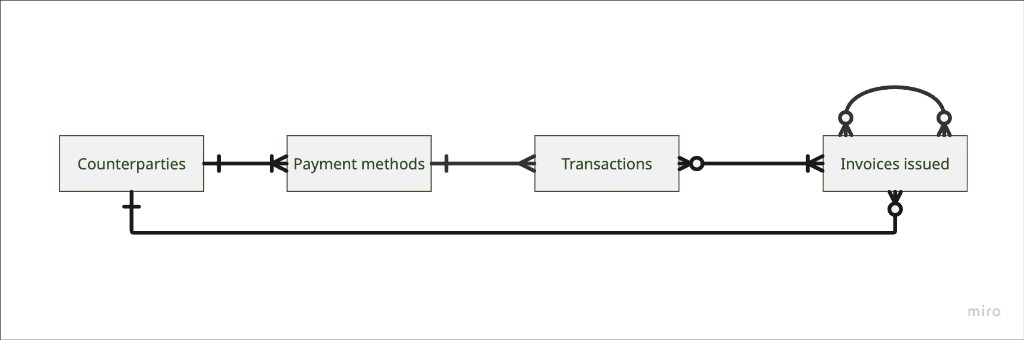
The scheme above is the working model for these objects:
- Counterparties → Payment methods (one to many). One counterparty can have one or more payment methods. Each payment method belongs to one counterparty.
- Payment methods → Transactions (one to many). One payment method can appear on many transactions. Each transaction points to one payment method.
- Counterparties → Invoices issued (one to many). One counterparty can have zero or many issued invoices or credit notes. Each issued document belongs to one counterparty.
- Transactions ↔ Invoices issued (many to many through matching). A transaction can be linked to zero or many issued documents (unmatched lines stay at zero; settled lines record one or more allocations). An issued document can be linked to one or many transactions as payments or refunds settle its open amount.
- Invoices issued → Invoices issued (self-relation). Issued documents can relate to other issued documents. The common case is an issued credit note linked to the original invoice it adjusts.
What each object is for
| Object | Job in Invunion |
|---|---|
| Counterparties | Stable identity for the customer or other party |
| Payment methods | Catalogue of banking or payment identifiers |
| Transactions | Cash movements to match, ignore, or leave unmatched |
| Invoices issued | Customer documents with open and settled amounts |
Current reconciliation scope
The current product focus is:
- incoming customer payments against issued invoices; and
- outgoing customer refunds against issued credit notes.
Supplier invoices and general outgoing expenses remain outside that settlement path, even when related objects exist.
Suggested reading order
If you have not tried the product yet, complete Getting started in 2 minutes with a demo environment or Generate a test dataset first so these objects appear with sample data.
Updated
Was this article helpful?
Feedback helps us improve the next version of this guide.